
Plain-English answers
The 20 questions I get asked most
Twenty questions from Board members and homeowners, answered the way I'd answer them on a call. Every one of these comes down to the same thing: where does the authority for this come from?
Want the long answers?
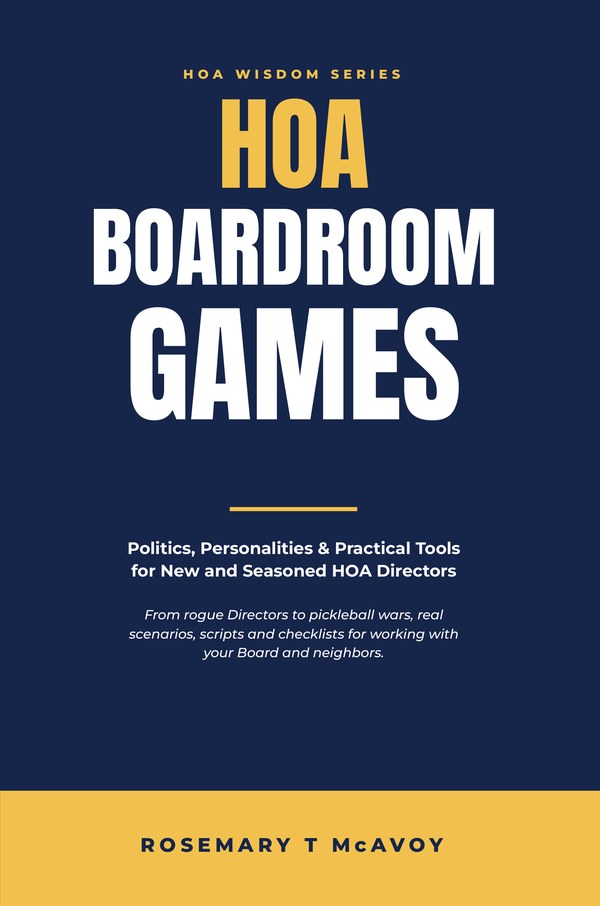
These are the short versions. The comprehensive treatment (the issues behind each question, real scenarios played out to their end, word-for-word scripts and the worksheets to go with them) is published in HOA Boardroom Games, my book for new and seasoned Directors.
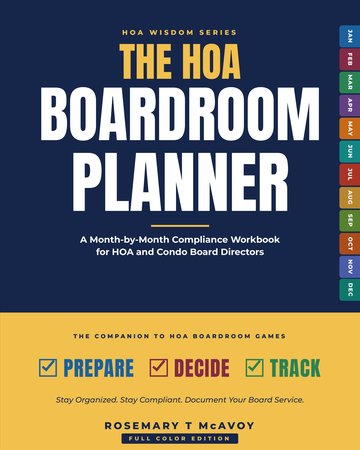
My companion workbook, The HOA Boardroom Planner, is a book you write in, not just read. Its oversized 8"×10" pages give you room to write your notes, think, plan, track and document your Board service all year. Available on Amazon in Black & White and Full Color.
These are general governance principles. Your governing documents and your state statute control, and they differ. I am an HOA educator and Past Board President, not an attorney. Nothing here is legal advice.
If you serve on the Board
- Can the Board vote by email?
- Does the President have authority to act alone?
- Can we hold a workshop owners can't attend?
- What does fiduciary duty actually require of me?
- A fellow director keeps acting alone. What do I do?
- Can a Committee decide things, or only recommend?
- Do we have to let owners speak at meetings?
- Can we take this into executive session?
- What has to be in the minutes?
- Can the Board adopt a rule without a membership vote?
If you live in an Association
- Can the Board fine me without a hearing?
- What records am I entitled to see?
- The Board said no. Can I appeal?
- Can they raise my assessment without a vote?
- The ARC denied my request with no explanation.
- Can I record a Board meeting?
- A Board member has a conflict of interest.
- Who do I complain to about the Board?
- What if the Board ignores the governing documents?
- Is it worth running for the Board myself?
If you serve on the Board
More in HOA Boardroom Games
Can the Board vote by email?
Almost never, and this is the single most common way Boards create a problem they then have to unwind. A Board acts through motions and votes taken at a properly noticed meeting. An email chain where four directors reply "sounds good" is not a vote. It produces no valid decision, and it is invisible to the owners who are entitled to see their Board govern.
Read more
Most states allow limited exceptions: a true emergency, or specific administrative acts named in the statute or your documents. Those exceptions are narrower than people assume, and they usually require ratification at the next open meeting anyway.
If a reply-all vote lands in your inbox, the useful sentence is: "I'd rather we take this up at a noticed meeting so it's on the record. If it's a true emergency, let's call a special meeting." You are not being difficult. You are protecting every director on that chain, including the one who started it.
Does the Board President have authority to act alone?
Only to the extent the Board has delegated it, in writing, in advance. The President presides at meetings and usually signs what the Board has authorized. That is a very different thing from deciding.
Read more
Many Boards do delegate limited spending authority (say, routine contracts under a set dollar amount) by Resolution. If your Board has done that, the Resolution will exist and you can read it. If nobody can point to it, it probably doesn't exist.
So when you hear "the President already approved it," the question is not confrontational, it's procedural: "When did the Board vote on that?" If the answer is that the Board didn't, you've found the problem, and the fix is to put it on the next agenda and decide it properly.
Can we hold a workshop that owners can't attend?
Usually not, and the word "workshop" has no magic in it. In most states, if a quorum of the Board gathers to discuss association business, that is a Board meeting whatever you call it, and meetings must be noticed and open to owners, with narrow exceptions.
Read more
It usually comes up with budgets, and the instinct is understandable. Working through a draft in front of an audience feels slow and exposed. But a budget shaped in a closed room and presented as finished is exactly the thing owners distrust most, and they're not wrong to.
There are two honest routes. Hold a noticed workshop that owners may attend. They rarely come, and the ones who do usually leave better informed. Or have the Treasurer and the manager prepare a draft for the Board to discuss in the open. Ask simply: "Will it be noticed and open to owners?"
What does fiduciary duty actually require of me?
It means you act in the Association's best interest, not your own, not your friends', and not the interest of the neighbors who voted for you. You wear two hats. When you walk your dog you are a resident. When you vote you are a director with a duty to every owner, including the ones who didn't want you elected.
Read more
In practice it is less lofty than it sounds. Read the packet before the meeting. Ask where the authority for a decision comes from. Disclose anything that could look like a personal stake and step out of that vote. Get bids. Take advice when the question is beyond you. Make sure the record reflects what actually happened.
Courts generally do not ask whether a Board was right. They ask whether it was informed, acted in good faith, and followed a reasonable process. That is a far more forgiving standard than most directors fear, but only if the process exists.
A fellow director keeps acting on their own. What can I do?
Start by assuming it is ignorance rather than malice, because it usually is. Most directors who instruct a vendor directly or promise a homeowner an outcome think they are being helpful and have no idea they have stepped outside their authority.
Read more
The escalation runs in order and you don't skip steps. A private word first. Then the Board adopting a written policy on who may direct the manager and vendors, which addresses the behavior without naming anyone. Then a formal discussion at a meeting, in the minutes. Then counsel, if the exposure is real.
What you should not do is handle it by email to the whole Board, or in front of owners. Both turn a correctable habit into a faction, and factions outlast the problem that created them.
Can a Committee make decisions, or only recommendations?
By default, Committees recommend and the Board decides. A Committee only has the authority the Board gave it, and that grant should be in a written charter or Resolution naming its purpose, its members, its limits and its end date.
Read more
Some Committees are different because the documents or the statute make them so: architectural review Committees often hold real decision authority, and in many states a fining or violation Committee must be independent of the Board and its decision is binding on whether a fine may be imposed. Read your own documents rather than assuming.
The question to ask when a Committee reports is simple and it saves a great deal of trouble: "Is this Committee bringing us a recommendation, or has the Committee already acted?"
Do we have to let owners speak at meetings?
In most states, yes. Owners have a right to speak on items the Board will act on, and the Board may adopt reasonable rules about time limits, signing up in advance and staying on the agenda item. Reasonable rules are fine. Silence is not.
Read more
Beyond the legal requirement, owner comment is free due diligence. The person who has lived beside the drainage swale for nineteen years knows things the engineer's report does not. Boards that treat comment as an obstacle lose information they are paying consultants to rediscover.
If the chair moves to a vote without hearing owners on an action item, it is entirely proper to say: "Before we vote, do we have any owners who'd like to speak on this item?"
Can we take this into executive session?
Only for the specific reasons your statute and documents allow. The usual list is narrow: pending or threatened litigation, advice from counsel, personnel matters, contract negotiation in some states, and individual owner matters such as delinquencies or violation hearings where privacy is owed to that owner.
Read more
"It would be awkward in public" is not on the list. Neither is "the owners will overreact." Closing the door on a decision owners are entitled to watch creates far more suspicion than the awkward conversation would have.
Ask before the door closes: "Which exception does this fall under?" And remember that any decision reached in executive session generally still has to be voted on in open session to be effective.
What has to be in the minutes?
Minutes are not a transcript and they are not a newsletter. They are the corporation's legal record of what it decided. In a dispute they are the first thing an attorney, an auditor, a buyer's lender or a judge will read.
Read more
What belongs: that notice was given and a quorum present, the agenda as approved, each motion in the words it was made, who moved and seconded, the vote count, and any director's vote recorded by name where they asked for it. Also any disclosure of conflict and recusal, and the fact that counsel was consulted, not what counsel said.
What does not belong: the argument, the personalities, who was annoyed. If you voted no on something you expect to be revisited, ask for your vote to be recorded by name. That is not grandstanding. It is the only way the record shows you raised the question.
Can the Board adopt a new rule without a membership vote?
It depends entirely on what kind of document you are changing, and this is where Boards most often overreach in good faith. A rule or regulation that implements something the Declaration already permits can usually be adopted by the Board. Amending the Declaration or the Bylaws almost always requires a membership vote at a stated percentage.
Read more
The trap is a "rule" that is really an amendment wearing a different hat. If it creates a new restriction on how owners may use their own property, rather than clarifying one that already exists, it is probably beyond the Board's rulemaking power regardless of what you call it.
Before any rule vote, make someone point to the clause that gives the Board authority to adopt it. "Which section says we can do that?" If nobody can find one, you have your answer, and it is far cheaper to find it now than after a year of enforcement.
For Directors
The HOA Boardroom Planner
Most of these answers come down to checking your authority before you act and getting it on the record. The Planner helps you do that every month. It's an oversized book you write in, not just read. The 8"×10" pages give you room to write your notes, think, plan, track and document your Board service throughout the year. The Authority Check, worksheets and Help Resources are all inside.
It's the companion workbook to HOA Boardroom Games, in Black & White and Full Color.

If you live in an Association
HOA or condo. Buying in? Start with HOA Wisdom
Can the Board fine me without a hearing?
In most states, no. The usual sequence is written notice of the specific violation, a stated opportunity to be heard before a Committee or the Board, and only then a fine, with the decision recorded. Many states also require that the hearing body be independent of the Board that brought the charge.
Read more
Skipping steps is common, and it is usually administrative sloppiness rather than malice. It also tends to make the fine unenforceable, which is why Boards who care about enforcement are the most careful about process.
Ask in writing, politely and specifically: which provision am I alleged to have violated, what is the process for contesting it, and when is the hearing? Put it in writing even if you are standing in front of them. Verbal requests leave no record that you asked.
What records am I entitled to see?
More than most owners realize. Typically the governing documents, minutes, budgets and financial statements, contracts, insurance policies, reserve studies and the membership roster, subject to limits and within a timeframe your statute sets.
Read more
Some things are properly withheld: records protected by attorney-client privilege, personnel files, and information about individual owners such as medical details or in many states their account status. The Association may usually charge reasonable copying costs, and may require the request in writing.
Make the request in writing, name the specific records rather than asking for everything, and cite the records provision in your documents. A narrow, specific request is far harder to refuse and far faster to fill than "I want to see the books."
The Board said no. Can I appeal?
There is rarely a formal appeal, but there is almost always a route back. A Board decision is not permanent. It can be reconsidered, and the thing that gets it reconsidered is new information or a flaw in how it was made, not repetition of the original request.
Read more
So ask yourself what they did not have. A bid they didn't see. A clause they didn't read. A neighboring association that solved it differently. Then submit it in writing and ask that it go on the agenda as a specific action item.
What rarely works is volume: more emails, more people, more heat. Boards dig in when they feel besieged, and a decision that becomes a matter of face is much harder to move than one that is simply wrong.
Can they raise my assessment without a vote of the owners?
Usually yes, within limits. Boards generally adopt the annual budget, and the regular assessment follows from it. Many documents cap how much the Board may increase it year over year without a membership vote, and some states impose their own cap. Special assessments more often require owner approval.
Read more
The real question is usually not whether they can, but whether the budget is sound. An association that underfunds its reserves keeps assessments artificially low for years and then faces a special assessment nobody can absorb. A rise that tracks a properly funded reserve schedule is the Board doing its job.
Ask for the reserve study and the budget-to-actual comparison. If the Board is raising assessments to fund reserves, that is good news dressed as bad news.
The architectural Committee denied my request with no explanation. Now what?
Ask for the decision in writing with the specific guideline it was based on. A denial that cites nothing is hard to comply with and hard to defend, and most review bodies will supply the reasoning once asked plainly.
Read more
Check two things while you wait. Whether your documents or statute impose a deadline for the Committee to respond; some provide that an application is deemed approved if not acted on in time. And whether the guideline being applied actually exists in writing, or is a preference that has hardened into custom.
Then resubmit addressing the stated reason, rather than arguing the reason was wrong. A revised application is a fresh decision. An argument is a rematch, and rematches are harder to win.
Can I record a Board meeting?
In many states owners may record open meetings, and the Board may adopt reasonable rules: equipment not blocking the view, no disruption, advance notice. Some states are clearer than others, and executive sessions are generally not recordable.
Read more
Worth thinking about before you do it, though: recording changes the room. Directors become careful, discussion becomes scripted, and the candor you were hoping to capture is usually the first casualty.
If your goal is an accurate record rather than evidence, the better route is to read the draft minutes when they circulate and submit corrections in writing. Corrections requested in writing and recorded in the minutes carry more weight than a recording nobody will listen to.
A Board member has a conflict of interest. Does that invalidate the decision?
Not automatically. What matters is whether the interest was disclosed and whether the interested director took part. The expected practice is disclosure on the record, recusal from the discussion and the vote, and the minutes reflecting both.
Read more
An undisclosed interest is the serious version: a director whose relative's company got the contract, or who stands to gain personally from a decision nobody knew they had a stake in. That can expose both the director and the Association.
If you suspect one, ask factually and without accusation: is there any relationship between a director and this vendor that should be disclosed? Asked that way, it is a governance question rather than a charge, and it is much harder to deflect.
Who do I complain to about the Board?
There is less external oversight than most owners expect. Some states have an agency with limited jurisdiction over community associations, and some offer mediation or arbitration before a lawsuit. Most do not police ordinary Board decisions at all.
Read more
In practice the real remedies are internal and they are more powerful than they look. The records request that shows what actually happened. The documented, specific complaint that the Board must answer on the record. The election. Recall, where your documents provide for it.
Before any of that, exhaust the process properly and in writing. Not because it is satisfying, but because every route that follows (mediation, an agency, counsel) will ask what you did first, and "I complained at a meeting" is a weaker answer than a paper trail.
What if the Board simply ignores the governing documents?
First, be certain that is what is happening. A great many apparent violations turn out to be a provision that was amended, a document superseded by a newer one, or a statute that overrides what the Declaration says. Make sure you are reading the current version before you build a case on it.
Read more
If it is real, put it in writing to the full Board, citing the section, asking a specific question and requesting a response by a date. Keep the correspondence. A Board that is genuinely mistaken will usually correct course when shown the clause; a Board that will not respond has told you something useful.
Only then consider counsel, and be honest with yourself about proportion. Litigation against your own association is slow, expensive and partly self-funded: you are a member of the body paying to defend it. That is not a reason never to do it. It is a reason to be sure.
Is it worth running for the Board myself?
If you are asking because one decision made you angry, probably not. Anger is a poor reason to take a three-year obligation, and a director who arrives to fix one thing usually discovers it was decided before they got there and cannot be undone by one vote.
Read more
If you are asking because you keep noticing that decisions are made without process, that is a much better reason. Associations are not short of opinions. They are short of people willing to read the packet.
Go to meetings for a few months first. Read a year of minutes. You will learn more about whether you want the seat from that than from any campaign. And if you do run, know going in that overnight you become "them" to the neighbors who are currently agreeing with you.
Your question isn't here?
Book Boardroom Backup, a private session: one person, one question, thirty minutes. You send the situation in advance, I read it before we speak, and we spend the time on the answer instead of the backstory.